Just the other day, I was chatting with my friend Peggy and the topic drifted to what a great place the Swan Valley (Western Australia) is. Then she asked me if I went to Taylors. Yes, I did thanks to Shasa Stone from the City of Swan who hosted us. But, my point is, the subject of Taylors kept popping up when I speak with different people about the Swan Valley.
It seems anyone who has been to the Swan Valley remembers Taylors.
So, what is Taylors Art & Coffee House like?

I brought a stubborn bug with me to Perth, Australia - I was infected with the hipster cafe hopping bug and took it everywhere I went. My good friend Jo-Hann who lives in Perth tells me that I have to check out La Veen, one of his favourite coffee places.

Day 4 of our food and wine tour of Swan Valley near Perth in Western Australia. It's the last day of our tour of Perth's "Valley of Taste" and seriously, the beauty and flavours of the place just whetted my appetite for many more return visits.
 Day 3 of our 5 day food and wine trail of Swan Valley, Perth's "Valley of Taste".
 Day 2 of our 5 day Swan Valley food and wine trail. The highlights were "Speed Grazing", Caversham Wildlife Park and the prestigious Singapore Airlines Swan Valley Wine Show.

I just came back from a most amazing 5 day food and wine tour of the Swan Valley in Australia (near Perth). The Swan Valley is indeed Perth’s “Valley of Taste”. For wine and food lovers, the Swan Valley offers a top notch lifestyle experience within 5 hours hop from Singapore and at a reasonable price.
 This is a special post unlike the usual stall or restaurant recommendations. It's about the traditional foods of Australia's aboriginal peoples as recorded in their ancient rock paintings, before contact with Europeans.
(I had the chance to view the aboriginal rock paintings in Australia's Kakadu National Park as the prize for winning the Best Food Blog at the Singapore Blog Awards 2013.)
Australia's aboriginal people recorded their everyday lives in the caves where they lived for over 50,000 years. Food, of course, is a big part of life and hence are featured prominently in the rock paintings. From the rock paintings at Nourlangie Rock and Ubirr Rock in Kakadu National Park, we able to piece together some aspects of what the aboriginal peoples ate and how they lived.
This is a special post unlike the usual stall or restaurant recommendations. It's about the traditional foods of Australia's aboriginal peoples as recorded in their ancient rock paintings, before contact with Europeans.
(I had the chance to view the aboriginal rock paintings in Australia's Kakadu National Park as the prize for winning the Best Food Blog at the Singapore Blog Awards 2013.)
Australia's aboriginal people recorded their everyday lives in the caves where they lived for over 50,000 years. Food, of course, is a big part of life and hence are featured prominently in the rock paintings. From the rock paintings at Nourlangie Rock and Ubirr Rock in Kakadu National Park, we able to piece together some aspects of what the aboriginal peoples ate and how they lived.
 Kakadu National Park is blessed with flood plains, billabongs (large ponds) and mangroves. Fish, therefore, are a big part of the aboriginal diet.
 Barramundi fish are frequently featured in the rock paintings.
 Barramundis are large brackish water fish that are also found in the mangroves of Johor where they are known as Sea Bass 金目鲈.
 On the right, under the arrow, is the large traditional aboriginal fish trap woven with vine.
 This is what an aboriginal fish trap, made with vines, looks like in real life. This example is at the Museum and Art Gallery of the Northern Territories in Darwin.
 Not surprisingly, kangaroos and wallabies feature prominently in the aboriginal diet as these important sources of protein are abundant.
 Kangaroos are hunted by throwing spears.
 Can you see the big bellied Monitor Lizard?
 The long necked turtle. The fat from turtles (and other animals) is considered a delicacy.
Aboriginal peoples usually eat their meats raw.
Other important food not seen in the rock art at Kakadu National Park are emus (large flightless bird like an ostrich) and crocodiles which are common in this region. As hunter gatherers, plants and insects are also part of the aboriginal diet.
Acknowledgement: My trip to Darwin was graciously supported by Northern Territories Tourism Australia and Singapore Press
Return to home page.
The long necked turtle. The fat from turtles (and other animals) is considered a delicacy.
Aboriginal peoples usually eat their meats raw.
Other important food not seen in the rock art at Kakadu National Park are emus (large flightless bird like an ostrich) and crocodiles which are common in this region. As hunter gatherers, plants and insects are also part of the aboriginal diet.
Acknowledgement: My trip to Darwin was graciously supported by Northern Territories Tourism Australia and Singapore Press
Return to home page.
This is a photo essay of my 9 day trip to Australia's Northern Territories. The trip hosted by Tourism NT (Australia) is a prize for winning the Best Food Blog at the annual Singapore Blog Awards 2013 organised by Singapore Press Holdings.
As a foodie blogger, I was not only looking out for things that make me drool but also things to feast my eyes and that provide food for thought.
Here are some of my photos and musings about the very enjoyable and eye opening trip.
 At the tropical "Top End" of Australia, there are many billabongs which are large fish filled ponds where many birds, animals, insects and reptiles congregate. The birds come to eat the insects and fish, the animals eat the birds, and the Kings of the Billabong are here to eat the everybody :p Got to watch out for crocodiles. When we were there, the headline news was a young man taken by crocodiles when he went for a night swim in croc infested waters.
 The sunrise cruise at Yellow Water which is a large billabong was a surreal experience. The billabong was as still as water in a glass bowl. The atmosphere was so serene, people around automatically spoke in hush whispers as though afraid to wake up the animals or maybe the spirits (?).
 A saltwater crocodile coming up for lunch at the "Spectacular Jumping Crocodile Cruise" on the Adelaide River. The crocs are wild and the boats dangle pieces of meat to encourage random crocs to jump for their food.
 This is no trained reptile or circus stunt - jumping is a natural behaviour of crocodiles as they leap to reach unsuspecting birds and mammals perched on branches above the water.
 One of the best dining experiences in Australia is none other than the BYO DIY or bring-your-own do-it-yourself Aussie barbie.
 These are termites you'll welcome around the house. The termites that built this giant nest known as a Cathedral Termite Mound at Litchfield National Park eat only dead leaves that have fallen to the ground. Don't you like them? :)
 A female Golden Orb spider (the size of a man's palm) at the waterfalls at Litchfield National Park waiting for her lunch to self deliver. The bite of the Golden Orb spider is venomous - fortunately, though painful it is not lethal to humans.
 Icy thirst quenchers at Alice Springs Airport smack in the centre of the vast Australian continent. From Alice Springs, we take a short hop of a flight to Uluru, a huge natural rock known as the Red Centre.
 I saw this huge red rock over twenty years ago from 30,000 feet up in the air, on the way between Sydney and Singapore. Never would I expect to ever touch this red beauty by way of blogging about the hawker food of Johor :)
 Picnickers waiting for sunset at Uluru with wine, champagne and sandwich in hand. I really like the way people here respect nature. There were about a couple of hundred picnickers but when they left, there were only footprints to show that they were here before. It's as if, no human had ever been here for the entire millennium.
 We learnt dot painting from this Aboriginal artist. Got an idea to redo my blog and Facebook page covers in dot painting style :)
 The lady completed this beautiful painting on the spot while we were there at Maruka Arts Dot Painting Workshop.
 We went to the Sounds of Silence dinner in style - sailing pass Uluru on "ships of the sea". You've heard that New Zealand has more sheep than people. Did you know that Northern Territories has more camels than people? You see when the early explorers came to Australia, they brought along camels to take them across the vast Australian outback. When the explorers returned home, they left the camels behind and the animals flourished.
 The fascinating rock paintings at Kakadu National Park show scenes of everyday life of Australia's aboriginal people.
 Food features prominently in aboriginal rock paintings. Barramundi fish are plentiful and popular with aboriginal peoples. In Singapore and Malaysia, this is known as Sea Bass. I love wild Sea Bass which are caught at the mangroves around Johor and can be found in Johor seafood restaurants. Wild Sea Bass can be as large as 5 kilos in weight.
 This rock painting showing an aboriginal hunter spearing a kangaroo.
 Today, a spritely aboriginal elder deftly throws a wooden spear at a dummy rabbit or kangaroo at a demonstration at the Sails in the Dessert Hotel, a delightful Five Star oasis in the dessert near Uluru.
 Waiting for sunset at Stokes Hill Wharf in Darwin. I have not seen such breathtaking supermarine sea and blue skies for a long, long time. It can get a little hot, hence the Chinese style folding paper fans in the foreground.
Acknowledgement: My trip to Darwin was graciously supported by Northern Territories Tourism Australia and Singapore Press Holdings.
Return to home page.
Waiting for sunset at Stokes Hill Wharf in Darwin. I have not seen such breathtaking supermarine sea and blue skies for a long, long time. It can get a little hot, hence the Chinese style folding paper fans in the foreground.
Acknowledgement: My trip to Darwin was graciously supported by Northern Territories Tourism Australia and Singapore Press Holdings.
Return to home page.
 It was our last day in Darwin with a plane to catch in the afternoon. Since we had already visited the Rapid Creek and Mindil Beach Markets, it was no surprise that we were going to make a dash for the Nightcliff Markets before boarding the plane.
Nightcliff Markets opens only on Sunday mornings and caters to all residents - there is something for everyone, young and old.
Still, handmade arts, and also crafts, is the name of the game here at Nightcliff Markets. Artists, artisans and craftsmen show off their intricate creations to browsers at the Markets.
It was our last day in Darwin with a plane to catch in the afternoon. Since we had already visited the Rapid Creek and Mindil Beach Markets, it was no surprise that we were going to make a dash for the Nightcliff Markets before boarding the plane.
Nightcliff Markets opens only on Sunday mornings and caters to all residents - there is something for everyone, young and old.
Still, handmade arts, and also crafts, is the name of the game here at Nightcliff Markets. Artists, artisans and craftsmen show off their intricate creations to browsers at the Markets.

 These handcrafted coloured glass Kingfishers fascinate me.
 Look whose here at the Nightcliff Markets :) Intrepid Australian TV personality, author and adventurer Monte Dwyer selling his books about his experiences in the rough Aussie outback.
Like any Aussie Sunday market, food is a big part of Nightcliff Markets.
Look whose here at the Nightcliff Markets :) Intrepid Australian TV personality, author and adventurer Monte Dwyer selling his books about his experiences in the rough Aussie outback.
Like any Aussie Sunday market, food is a big part of Nightcliff Markets.
 The juice and ice cream lady listening patiently as the boys ponder their orders :)
 Hawker selling popular Vietnamese street snacks. There were also Thai, Chinese and Indian food on sale.
 The crepe stall is the food stall with the longest queue at Nightcliff Markets.
 This French gentleman fries peanuts with caramel in a large copper bowl.
 The friendly satay man is from Surabaya, Indonesia.
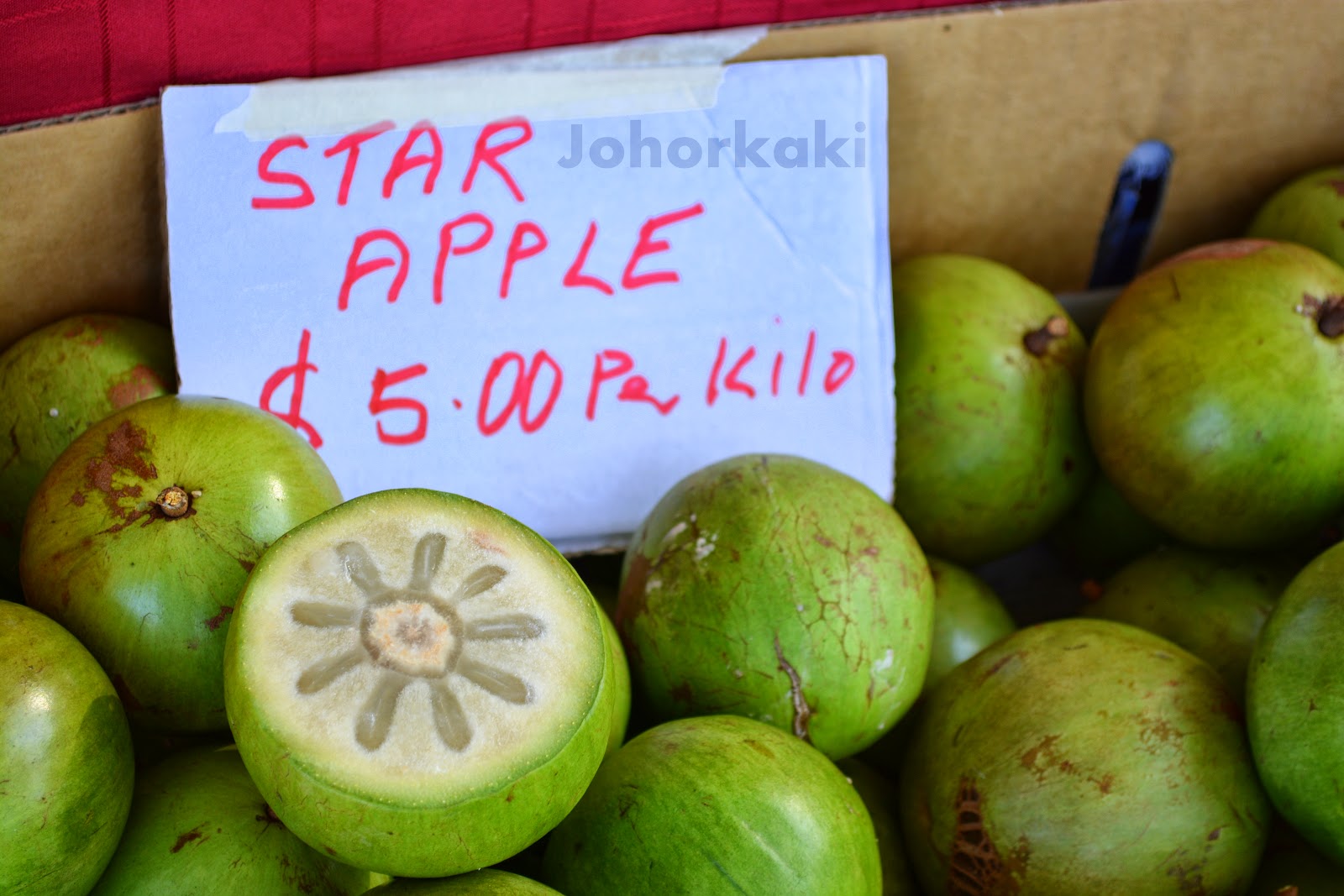
 There are a couple of small vegetable and fruit stalls. These green "Star Apples" caught my eye as I have never seen anything like these before.
 Relaxing with friends at the sidewalk café is a favourite, laid back Sunday morning pastime for many Darwinians.
 Nightcliff Markets is dizzy fun for children.
 At Nightcliff Markets, you can turn your back to the world for a while and get a solid sidewalk massage at a good price.
 At the Nightcliff Markets, you could have a fortune teller look into the window of your soul, if you allow.
 The Nightcliff Markets is easily accessed by Darwinbus. Clean, comfortable, on schedule. AUD3 for 3 hours unlimited rides. With working free wifi onboard and at bus stops.
 The ladies couldn't wait till they are back at the hotel before they compare their latest loot.
I didn't buy or eat anything, but was very satisfied with taking another colourful, delicious slice of Darwin everyday life.
Acknowledgement: My trip to Darwin was graciously supported by Northern Territories Tourism Australia and Singapore Press Holdings.
Nightcliff Markets
Address: Pavonia Place, Darwin, Northern Territories, Australia
Map: http://goo.gl/maps/MR6gs
GPS: -12.386721,130.850075
Hours: 8:00am to 2:00pm (Sunday only)
Date visited: 1 Sep 2013
Return to home page.
The ladies couldn't wait till they are back at the hotel before they compare their latest loot.
I didn't buy or eat anything, but was very satisfied with taking another colourful, delicious slice of Darwin everyday life.
Acknowledgement: My trip to Darwin was graciously supported by Northern Territories Tourism Australia and Singapore Press Holdings.
Nightcliff Markets
Address: Pavonia Place, Darwin, Northern Territories, Australia
Map: http://goo.gl/maps/MR6gs
GPS: -12.386721,130.850075
Hours: 8:00am to 2:00pm (Sunday only)
Date visited: 1 Sep 2013
Return to home page.